.png)


.png)
How Women Leaders Use Critical Thinking to Navigate Complexity and Drive Results
The board is pushing for aggressive expansion into a market you're not sure about. Your CFO says the numbers work. Your CMO says the brand is ready. Your gut says wait. You have 48 hours to decide.
Or: Your top performer just resigned, and three team members want her role. Each has a compelling case. The wrong choice could trigger a cascade of departures. You have one week.
Or: A competitor just launched a product that makes yours look obsolete. Your team wants to react immediately. Industry analysts are writing your obituary. You need a response today.
These aren't hypotheticals—they're Tuesday. And the difference between leaders who thrive under this pressure and those who crack isn't intelligence, experience, or even intuition. It's critical thinking: the ability to cut through noise, complexity, and bias to make sound decisions when everything is on the line.
Why Critical Thinking Matters More for Women Leaders
Every leader needs critical thinking skills. But for women in leadership, they're not just nice to have— they're essential for survival. Because women leaders operate in an environment where their decisions are scrutinized more closely, their mistakes remembered longer, and their judgment questioned more frequently.
The Double Standard in Numbers:
In this environment, critical thinking isn't just about making good decisions—it's about making defensible ones. It's about building such rigorous thought processes that when your judgment is questioned (and it will be), your reasoning is bulletproof.
The Critical Thinking Framework: 6 Questions That Change Everything
Critical thinking isn't magic—it's method. The best leaders use a systematic framework to analyze problems, evaluate options, and make decisions. Here are the six questions that separate reactive leadership from strategic leadership:
Question 1: What Problem Am I Actually Solving?
Most leadership failures start here: solving the wrong problem brilliantly. Before you strategize solutions, ruthlessly define the actual problem.
The Problem Definition Framework:
Example: Your team says: 'We need to hire faster.' The real problem might be: retention is broken, onboarding is inadequate, or you're hiring the wrong profiles. Solve the wrong problem and you'll hire faster—and lose people even faster.
Question 2: What Do I Know, What Do I Think I Know, and What Do I Need to Know?
Critical thinkers distinguish between facts, assumptions, and gaps. Most bad decisions come from treating assumptions as facts or ignoring critical information gaps.
The Knowledge Audit:
WHAT I KNOW (Facts) - Data, verified information | Customer churn is 15%, Revenue down 20% Q3
WHAT I THINK (Assumptions) - Beliefs requiring validation | It's due to pricing, Market is contracting
WHAT I NEED (Gaps) - Missing critical information | Why they actually left, Competitor actions, Macro trends
Question 3: What Are My Cognitive Biases Right Now?
Every leader has biases. Exceptional leaders know which ones they're most susceptible to and actively counteract them.
Common Leadership Biases to Watch:
Confirmation Bias: Seeking information that confirms what you already believe
Recency Bias: Over-weighting recent events while ignoring longer-term patterns
Sunk Cost Fallacy: Continuing investment because of past investment, not future value Availability Bias: Judging likelihood based on how easily examples come to mind
Anchoring Bias: Over-relying on the first piece of information received
Groupthink: Conforming to team consensus to avoid conflict or seem collaborative
Debiasing Strategy: Before any major decision, ask: 'What would I believe if the opposite were true?' Force yourself to argue the other side.
Question 4: What Are the Second and Third-Order Consequences?
Weak leaders think one move ahead. Strong leaders think three moves ahead. Critical thinkers map the cascade.
The Consequence Cascade:
Example: Decision: Cut prices 30% to gain market share.
First-order: Sales volume increases.
Second-order: Competitors match, margin erodes, brand perception cheapens.
Third-order: Can't afford R&D, product quality declines, lose premium customers, death spiral.
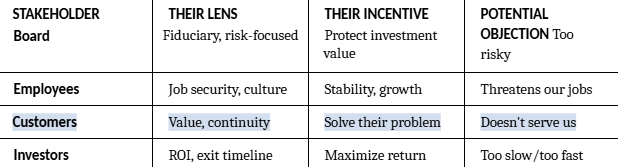
Question 5: Who Has a Stake, and What's Their Lens?
Every stakeholder sees the same situation differently based on their incentives, information, and interests. Critical thinkers map stakeholder perspectives before deciding.
Stakeholder Analysis Matrix:
Question 6: What Would I Decide If This Weren't My Problem?
When we're too close to a problem, ego, emotion, and investment cloud judgment. The 'outsider test' creates distance.
The Outsider Test Questions:
The Critical Thinking Process: From Analysis to Action
Questions are useful. But critical thinking demands a systematic process that moves from inquiry to decision. Here's the framework the best leaders use:
Step 1: Slow Down (Even When Everything Says Speed Up)
Critical thinking requires space. When pressure mounts, resist the urge to decide immediately. Build in a 'decision buffer'—even 30 minutes of structured thinking beats hours of reactive scrambling.
Step 2: Separate Analysis from Advocacy
Analyze the situation objectively before considering your desired outcome. Once you know what you want, you stop seeing clearly. See first, then decide what you want.
Step 3: Seek Disconfirming Evidence
Actively hunt for information that contradicts your hypothesis. Ask: 'What would prove me wrong?' Then go find it. If you can't find it, you're not looking hard enough—or you might actually be right.
Step 4: Consult Strategically
Get input, but be selective. Ask people who: (1) Have relevant expertise, (2) Will disagree with you, (3) Have no stake in the outcome. Avoid asking people who will just validate what you already think.
Step 5: Make the Call, Then Commit
Critical thinking doesn't mean endless analysis. It means rigorous analysis, then decisive action. Once you decide, commit fully. Second-guessing post-decision is where good decisions die.
Building Your Critical Thinking Practice: The 30-Day Challenge
Critical thinking is a skill, not a trait. Like any skill, it improves with deliberate practice. Here's your 30-day program to transform how you think:
Week 1: Problem Definition Practice
Week 2: Bias Recognition
Week 3: Consequence Mapping
Week 4: Integrated Practice
When Critical Thinking Isn't Enough: The Role of Intuition
Here's the paradox: the best critical thinkers also trust their intuition. But they know when to use which tool.
Use Critical Thinking When:
Use Intuition When
The Integration:
The best leaders use critical thinking to train their intuition. By rigorously analyzing decisions and their outcomes over time, you develop pattern recognition that makes intuition more accurate.
The Bottom Line: Think Like Your Success Depends On It (Because It Does)
In a world of information overload, competing pressures, and high-stakes decisions, your ability to think clearly is your most valuable asset. Not your network, not your experience, not your charisma—your thinking.
For women leaders navigating an environment that scrutinizes their every move, critical thinking isn't optional. It's the foundation of defensible decision-making, the source of unshakeable confidence, and the differentiator between leaders who survive and leaders who transform industries.
The good news? Critical thinking isn't innate—it's learned. It's practiced. It's developed. And every day presents a new opportunity to get better at the skill that matters most.
The question isn't whether you can think critically. The question is: are you practicing the skill that will determine everything else?
Because in the end, your decisions are only as good as the thinking that produces them.
728X90 LEADERBOARD AD
Aspect 8.09:1

Subscribe to our weekly newsletter for curated insights navigating modern government contracting delivered directly to your inbox.


%20(1).png)
%20(1).png)